Understanding Core Beliefs: Why “I’m Not Good Enough” Can Feel So True

Have you ever worked hard for something, achieved it, and then heard a quiet voice say, “That was just luck. Sooner or later they’ll realise you’re not really capable”? Or received a compliment and instinctively brushed it off before it had a chance to land?
Many of us have moments like these. They can feel like passing thoughts, but they often point to something deeper and more enduring: our core beliefs.
What are core beliefs?
Core beliefs are the deeply held, often unspoken assumptions we carry about ourselves, other people and the world around us (Beck, 2020). They act a bit like a pair of tinted glasses: we look through them rather than at them, so what we see feels like simple reality rather than one interpretation of it.
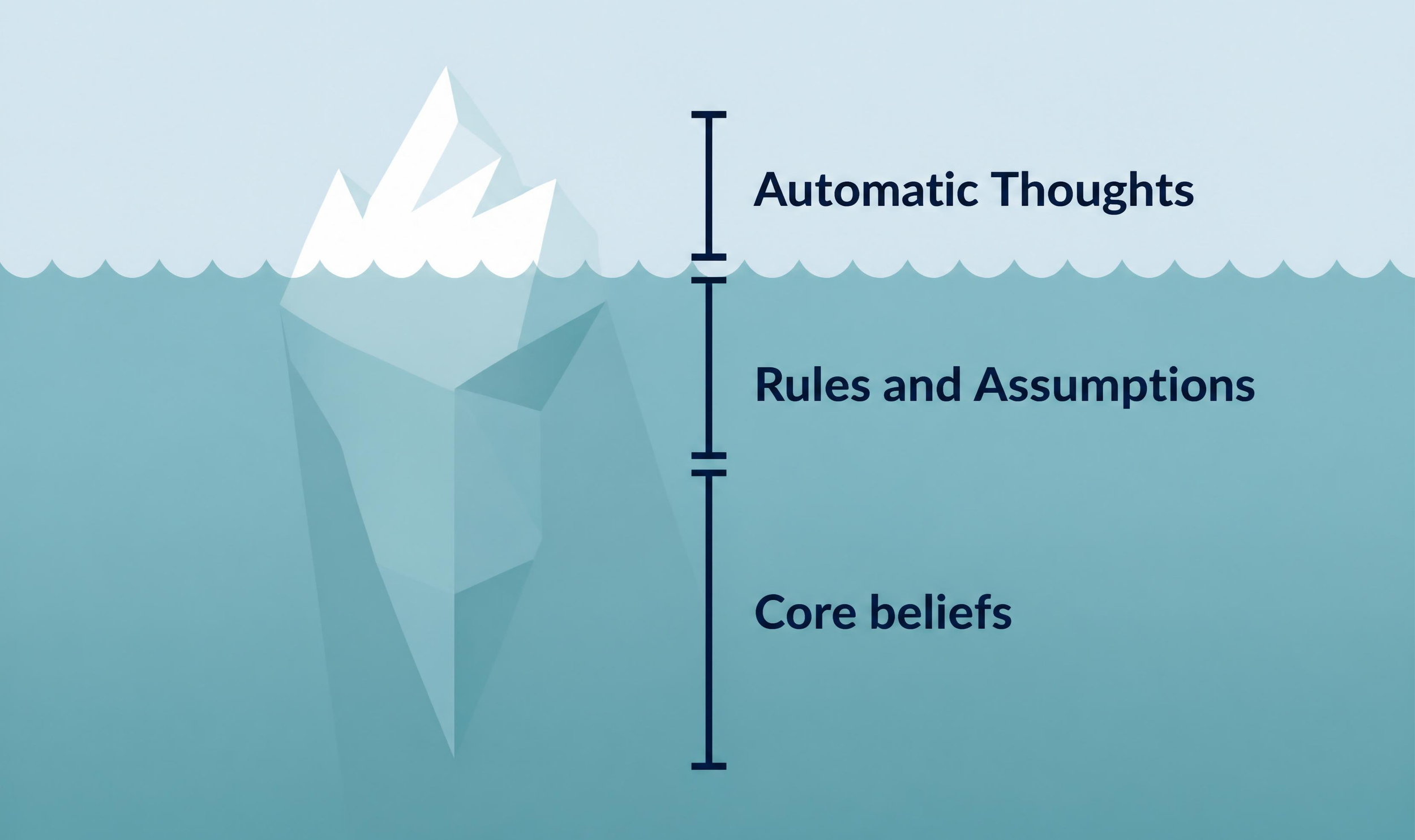
In Cognitive Behavioural Therapy (CBT), core beliefs are understood as the deepest layer of our thinking. A helpful way to picture this is an iceberg:
● Above the surface sit automatic thoughts. These are the more observable and in-the-moment thoughts we notice, such as “I’m going to stuff this up”.
● Just below sit rules and assumptions. These are the “if… then…” rules we have and “should” statements we live by, such as “If I don’t do everything perfectly, people will see I’m not good enough”.
● At the base are our core beliefs, holding everything else up. For example: “I’m not good enough”.
Core beliefs tend to be broadly applied, absolute statements. Common ones include “I’m not good enough”, “I’m unlovable”, “I’m a failure”, “Other people can’t be trusted”, and “The world is dangerous”. We all hold helpful core beliefs too, like “I’m capable” or “People are generally kind”. It’s the unhelpful ones that tend to cause distress and create a vulnerability to mental health problems, such as depression and anxiety.
How do core beliefs affect us?
Because core beliefs shape the lens we see through, they influence what we notice, how we interpret it, how we feel and what we do next.
Imagine someone who holds the belief “I’m not good enough” receives feedback on a work report. Their manager says it’s strong overall, with one section to tweak. Through the lens of their core belief, the praise barely registers. The one suggestion becomes proof: “See, I’m not good enough. I knew it”.
What follows is often a wave of anxiety, shame or low mood. They might stay back late rewriting the whole report, lie awake replaying the conversation, or decide not to put their hand up for the next project.
Over time, “I’m not good enough” can show up in many areas of life:
● Work and study: perfectionism, procrastination, imposter feelings, or burnout
● Relationships: people-pleasing, difficulty saying no, or needing lots of reassurance
● Self-care: harsh self-criticism and difficulty resting without feeling guilty
● Opportunities: holding back from things we’d love to try, in case we fall short
Where do core beliefs come from?
Most core beliefs take shape early in life, as we try to make sense of our experiences with the limited understanding a child or adolescent has. For example, a core belief such as “I’m not good enough” might develop through experiences such as:
● Growing up with high expectations, or feeling that love and approval depended on achievement
● Frequent criticism or being compared with siblings, classmates or peers
● Being bullied, excluded, or made to feel different
● Having our emotional needs overlooked, for example in a busy or stressful household
● Painful or traumatic experiences, including discrimination or abuse
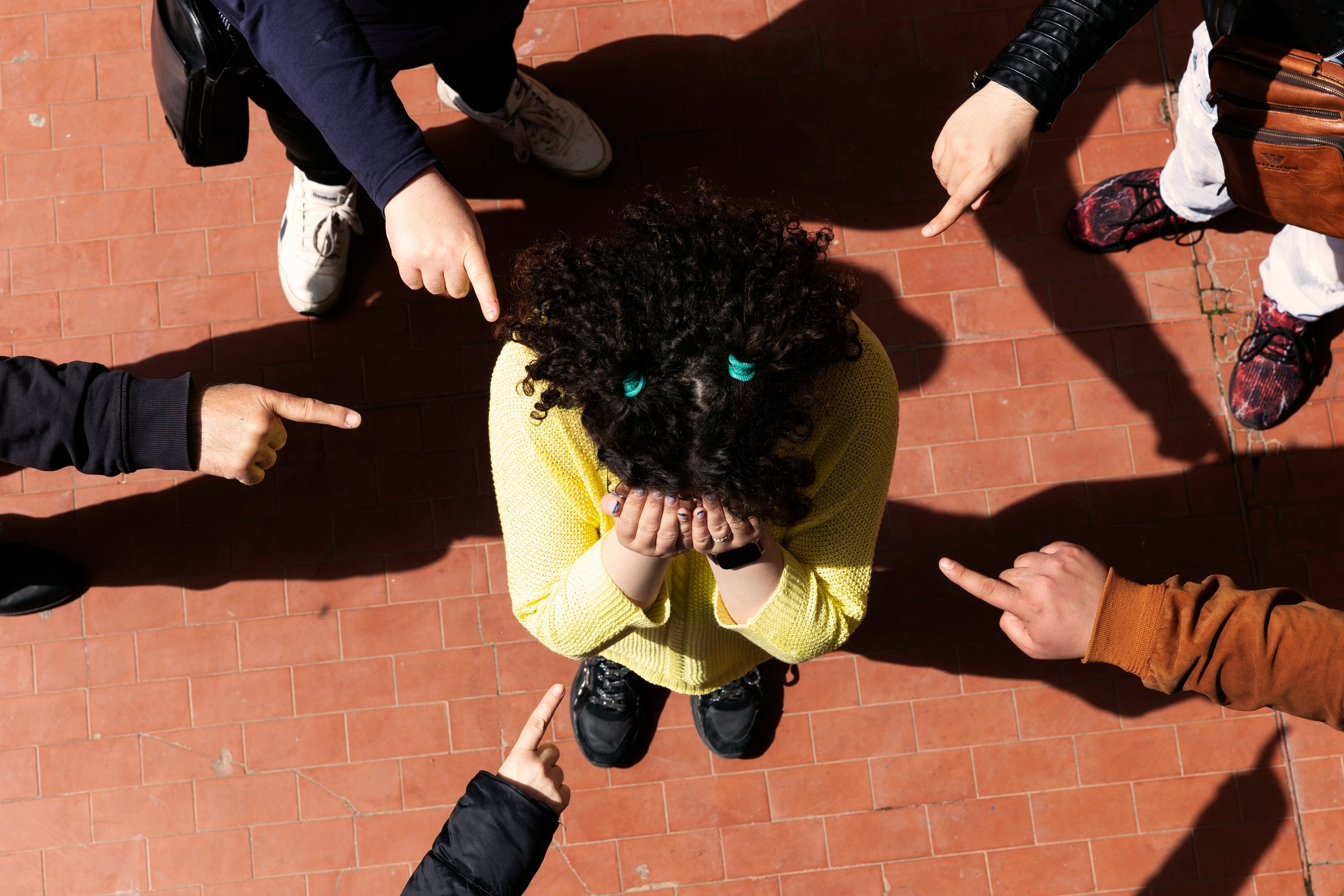
A young child can’t step back and think, “My parent is stressed and overwhelmed”. It often feels more logical to conclude, “There must be something wrong with me”. In this way, a core belief can be a young person’s way of reasonably explaining an unreasonable situation.
Core beliefs can also form or be strengthened later in life, through difficult relationships, workplace experiences or major life setbacks. Understanding where a belief came from isn’t about placing blame or pointing fingers at our parents. It’s about recognising that the belief was learned, rather than being a fact about who you are.
Why do core beliefs stick around?
If core beliefs are learned, why do they so often stay with us long after the original circumstances have changed? A few processes tend to keep them in place.
We notice what fits and dismiss what doesn’t. Our minds naturally look for information that confirms what we already believe. A mistake is mentally filed as “evidence”, while a success is explained away as luck, a fluke, or someone just being nice. This is sometimes referred to as an information processing bias.
We avoid situations that might test the belief. If “I’m not good enough” tells us not to apply for the new role, share our ideas, or try the new class, we never get the chance to discover that we might have done well. In other words, we miss the chance to create mental evidence that challenges the core belief.
We overcompensate. Some people respond to their core belief by working incredibly hard to prove it wrong, through perfectionism, overworking, or overpreparing. The catch is that success then gets credited to the extra effort, not to the person: “I only did okay because I stayed up all night”. The belief survives untouched, and burnout often follows.
The inner critic keeps it rehearsed. The more often we repeat a thought to ourselves, the more familiar it becomes. And the more familiar something is, the more it feels true.
None of this means someone is doing anything wrong. These patterns usually started as ways of coping and protecting ourselves. They just tend to keep the belief going.
Can core beliefs change?
Yes! Because core beliefs are learned, they can also be modified and updated.
It can help to think of a core belief like a well-worn walking track. We’ve travelled it so many times that our feet find it automatically. Creating a new path takes time and repetition, but with practice it becomes easier to walk, and the old track slowly starts to grow over.

In therapy, this often involves identifying what our belief is, understanding where it came from, and testing how accurate it really is. From there, we work on building a more balanced alternative, such as “I am enough as I am, even when I make mistakes”, and practising new ways of responding.
Therapeutic approaches like CBT and Schema Therapy offer helpful tools for this, and research shows that these deep-seated beliefs can genuinely shift with therapy (Kolubinski et al., 2018; Taylor et al., 2017). This is done using a combination of cognitive, behavioural, and experiential techniques that aim to break longstanding habits maintaining core beliefs, as well as provide corrective experiences to form new, more helpful beliefs.
You don't have to work through this alone
If you recognised yourself in some of this, you're far from alone. Beliefs like "I’m not good enough" are some of the most common things people bring to therapy, and simply noticing them is often the first step in loosening their grip.
Working with a psychologist can offer a supportive space to explore your own core beliefs, where they came from and what keeps them going, and to gradually build a more balanced view of yourself. There’s no need to wait until things feel unmanageable. Support can be helpful at any stage.
If you feel like you’re in a crisis or finding things unmanageable right now, Lifeline (13 11 14) and Beyond Blue (1300 22 4636) are available 24/7.
References
Beck, J. S. (2020). Cognitive behavior therapy: Basics and beyond (3rd ed.). Guilford Press.
Kolubinski, D. C., Frings, D., Nikčević, A. V., Lawrence, J. A., & Spada, M. M. (2018). A systematic review and meta-analysis of CBT interventions based on the Fennell model of low self-esteem. Psychiatry Research, 267, 296–305. https://doi.org/10.1016/j.psychres.2018.06.025
Taylor, C. D. J., Bee, P., & Haddock, G. (2017). Does schema therapy change schemas and symptoms? A systematic review across mental health disorders. Psychology and Psychotherapy: Theory, Research and Practice, 90(3), 456–479. https://doi.org/10.1111/papt.12112